What Does IP68 Mean? Water Resistance
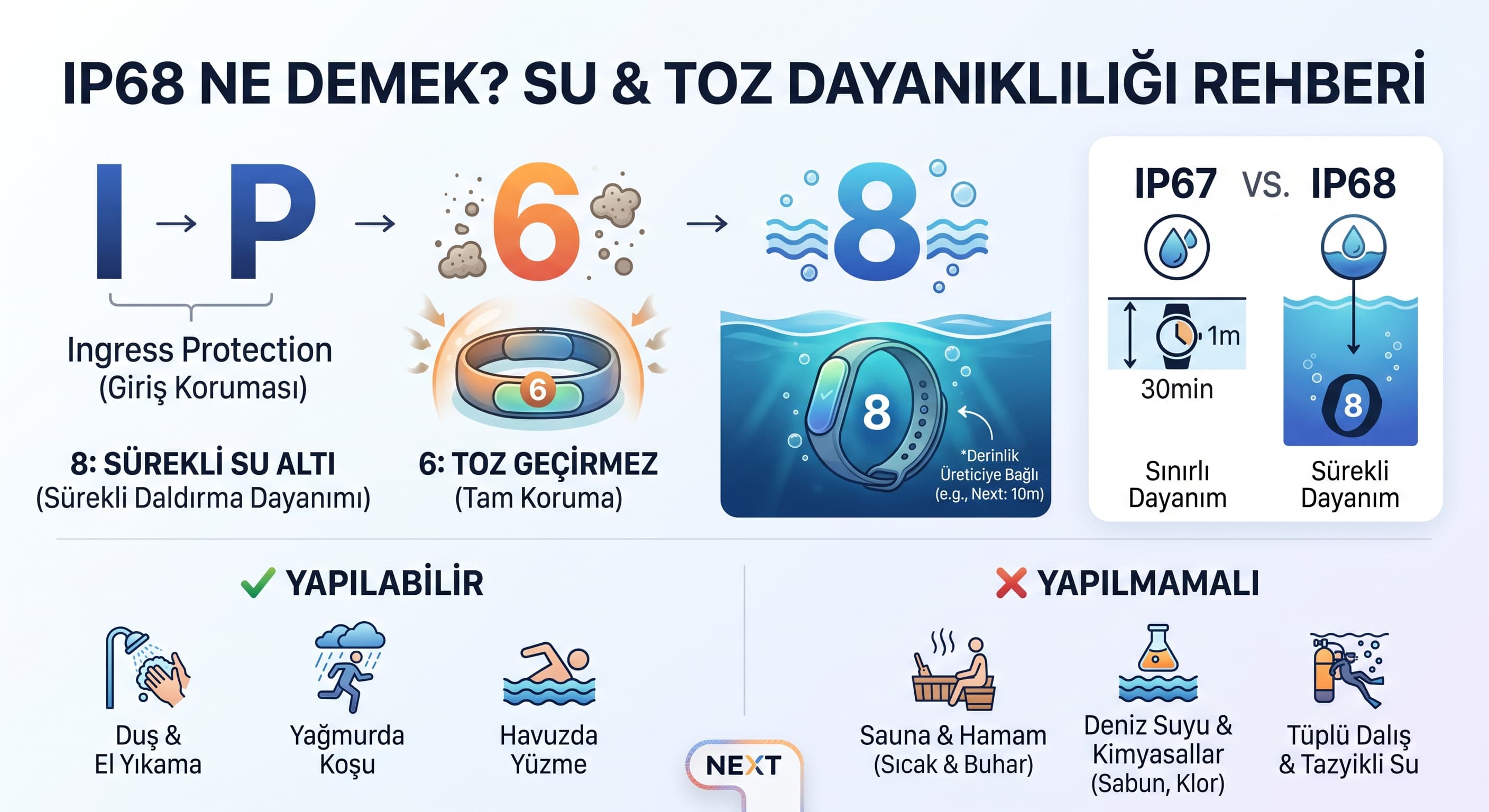
When a wearable's box says IP68, that is the result of a standardised code describing which dust and water tests the device has passed. So what does IP68 mean, how does it differ from IP67, and what can you actually do with it? This guide covers reading the code, its limits, and the care habits that extend your band's life.
What does IP68 mean?
IP stands for Ingress Protection and is defined by the IEC 60529 standard. The two digits describe two separate tests: the first covers solid objects, the second covers water. In IP68, 6 means dust-tight and 8 means resistant to continuous immersion in water.
An important detail: the depth and duration behind the "8" rating are not fixed by the standard — they are specified by the manufacturer. So two IP68 devices may not be equally durable. For Next Health Band that figure is 10 metres.
How to read the IP code
First digit — protection against solid objects:
| Digit | Protection |
|---|---|
| 4 | Objects 1 mm and larger |
| 5 | Partial dust protection (limited ingress permitted) |
| 6 | Dust-tight — no dust enters |
Second digit — protection against water:
| Digit | Protection |
|---|---|
| 4 | Splashing water from any direction |
| 5 | Low-pressure water jets |
| 6 | Powerful water jets |
| 7 | Immersion at 1 m for 30 minutes |
| 8 | Continuous immersion deeper than 1 m (depth set by manufacturer) |
IP68 versus IP67
| IP67 | IP68 | |
|---|---|---|
| Dust | Dust-tight | Dust-tight |
| Water | 1 m / 30 minutes | Beyond 1 m, continuous immersion |
| Showering, washing hands | Fine | Fine |
| Swimming in a pool | Not recommended | Generally fine |
| Running in the rain | Fine | Fine |
In short: both are equal on dust; the difference is in the duration and depth of water exposure.
What you can do with an IP68 band
- Shower and wash your hands
- Train in the rain and while sweating
- Swim in a pool (within the manufacturer's stated depth)
- Wash dishes and work in the kitchen
What you should not do
The IP68 test is performed with still, fresh water at room temperature. The following fall outside that scope and wear down the seals:
- Sauna, steam room, hot shower steam. Heat expands seals, and water vapour penetrates more easily than liquid water.
- Sea water and chlorinated pool water. Salt and chlorine damage seals and metal parts over time. Rinse with fresh water after getting out.
- High-pressure water. A strong tap jet, pressure washing, a water slide — the pressure far exceeds the tested condition.
- Scuba diving. Pressure rises with depth well beyond the manufacturer's rating.
- Soap, shampoo, perfume, sunscreen. Surfactants lower water's surface tension, making it easier to pass a seal.
Care that extends your band's life
- Rinse and dry after water. Especially after the sea or a pool: rinse with fresh water and dry with a soft cloth.
- Never charge it wet. The charging pins are the most vulnerable point; make sure it is completely dry.
- Keep the sensor window clean. Sweat residue and cream reduce PPG measurement accuracy.
- Clean the strap separately. Silicone straps hold sweat; a weekly warm-water wash also prevents skin irritation.
- Avoid sudden temperature changes. Going into cold water right after a hot shower creates a pressure difference inside the case.
Frequently asked questions
Is IP68 waterproof or water-resistant?
The correct term is water-resistant. IP68 shows the device was tested against still fresh water at a specific depth and duration. Pressure, temperature, salt and chemicals fall outside those conditions. No consumer device is unconditionally waterproof.
Can I shower with an IP68 band?
You can, but soap and shampoo degrade seals so it is not ideal, and hot shower steam is outside the test scope. If you want maximum longevity, taking it off before showering is safest; occasional showers will not cause harm.
Does water resistance decrease over time?
Yes. Seals age, impacts create micro-deformation in the case, and pins are stressed during strap changes. You should not assume a device used for several years retains its day-one resistance.
Water got inside my band — what should I do?
Remove it immediately, do not charge it, and leave it in a dry place at room temperature. Heat sources such as hairdryers or radiators damage seals and the battery. If condensation or malfunction persists, contact technical support.
Conclusion
The essence of what IP68 means: complete protection against dust, plus immersion resistance to the depth the manufacturer states. The code is a standardised test result, not a guarantee — and the conditions of that test (still, fresh, room-temperature water) do not always hold in daily life.
Next Health Band is IP68 certified and water-resistant to 10 metres, so it can stay on while you swim. For technical detail and corporate use, get in touch.
Water resistance is not a warranty term; damage caused by liquid contact is usually excluded from warranty. Follow the limits stated in your device manual.