What Is HRV? How to Read Your Data
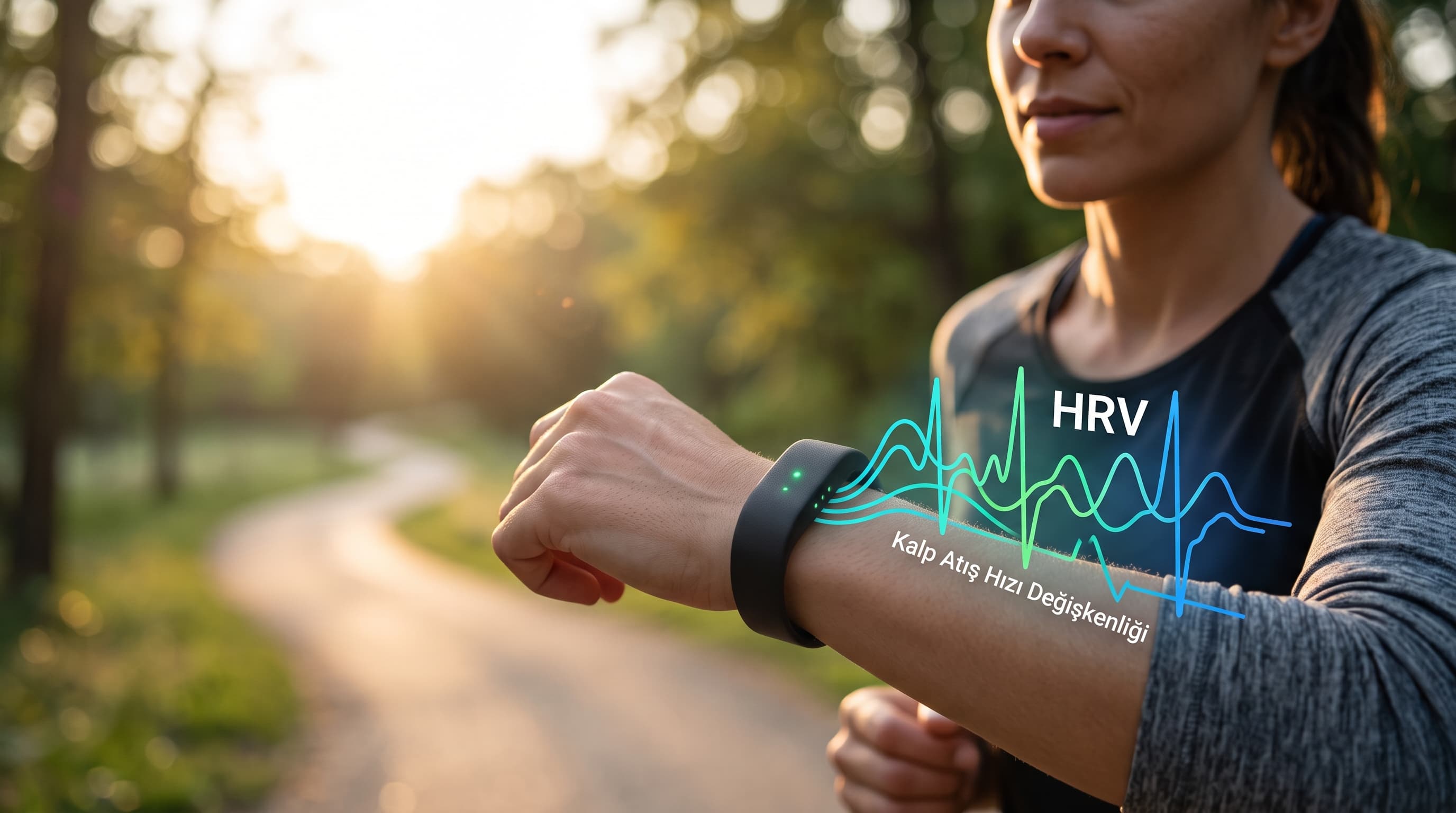
HRV (heart rate variability) measures how the interval between consecutive heartbeats changes, down to the millisecond. Unlike your pulse, it is not a single number — it is a read-out of how adaptable your body is right now. This guide explains what HRV is, why the data is personal to you, and how to turn the chart on your wearable into something you can act on.
What is HRV?
HRV is the variation in time between successive heartbeats. A heart beating 60 times a minute does not space each beat exactly one second apart; the intervals fluctuate between roughly 0.95 and 1.05 seconds. That fluctuation is HRV, and it reflects the balance between the two branches of your autonomic nervous system — the sympathetic branch that mobilises you and the parasympathetic branch that lets you recover.
The counter-intuitive part: more variability is generally better. A metronome-steady rhythm signals a loss of adaptability. A variable rhythm shows your body can adjust quickly to demand.
Why HRV matters
HRV is one of the few externally readable signals from a system you cannot control voluntarily. Training load, sleep quality, alcohol, the first hours of an infection and psychological stress all leave a mark on HRV — often before you consciously feel worse.
Its practical value is not prediction but timing: when your HRV sits clearly below your personal average, choosing light movement over a hard session, or closing the day early, is a reasonable call.
What is a normal HRV?
Let us be direct: there is no universal "normal" HRV. Two healthy people can differ by a factor of four or five. Age, genetics, resting heart rate, measurement method and the time of day all change the number.
Compare your HRV with your own 7-day average, never with someone else's. What carries meaning is deviation from your own baseline, not the absolute value.
Which is why the first two weeks are for collecting data. As your band measures through the night it learns your personal range; only then do daily values become informative.
What lowers and what supports HRV
| Lowers HRV | Supports HRV |
|---|---|
| Alcohol before bed | Consistent sleep and wake times |
| Short or fragmented sleep | Regular weekly aerobic movement |
| Consecutive hard training days | A planned rest day after hard sessions |
| The onset of an infection | Slow, deep breathing practice |
| Intense work stress, long screen time | Time spent in daylight |
| Heavy late-night meals | Adequate hydration and balanced meals |
How HRV is measured
In clinical settings ECG is the gold standard: electrodes record the heart's electrical activity directly. Wearables use PPG (photoplethysmography) instead — green light is sent into the wrist and blood-volume change is read from what bounces back. This method is sensitive to motion and strap fit, which is why the most reliable HRV data is collected during sleep.
We covered how PPG works and what degrades its accuracy in a separate article: wrist heart rate measurement and the PPG sensor.
The two metrics you will meet most often:
- RMSSD — the root mean square of successive interval differences. The most common value for short recordings and sensitive to parasympathetic activity.
- SDNN — the standard deviation of beat intervals. More meaningful for longer recordings.
How to read your HRV data
One low night means nothing on its own. Three things matter:
- Direction — is the 7-day average trending up or down?
- Deviation — has today's value moved outside your personal range?
- Context — what happened last night? Alcohol, a late meal, a hard session or poor sleep explains most dips by itself.
The AI-assisted health panel in Next Health Band shows all three layers together: today's value, your personal range and the weekly trend. Read alongside your sleep stage data, the source of a dip is usually visible on the same screen.
Frequently asked questions
How do I improve my HRV?
The three highest-impact changes are stabilising your sleep schedule, cutting alcohol especially in the evening, and making weekly aerobic movement consistent. Expect two to three weeks before the change shows in your data, because HRV fluctuates daily and the trend only clears with time.
Is low HRV a sign of illness?
Not on its own. HRV is a trend indicator for recovery and stress load, not a diagnostic tool. That said, if a marked multi-day drop comes with fatigue, palpitations or shortness of breath, it is worth raising with a doctor.
Why is my HRV different every morning?
Because HRV is highly sensitive to momentary physiology. Sleep duration, the timing of your last meal, room temperature, hydration and stress all vary night to night. This is why you track a weekly average rather than a single reading; day-to-day variation is normal.
How tight should the band be for HRV measurement?
Tight enough to stay in contact with your skin, loose enough not to restrict circulation. If there is a gap under the band, ambient light reaches the sensor and corrupts the data. For sleep tracking, wearing it a finger or two above the wrist bone gives the most consistent results.
Conclusion
The short answer to what HRV is: a recovery signal showing how adaptable your body is today. The longer answer is that the data only works when compared with your own baseline. Do not chase an absolute number — collect two weeks of data, watch the trend, and make room for recovery on the days it drops.
Next Health Band measures HRV through the night, learns your personal range and shows each daily value against it. Get in touch to see how it is used in corporate health programmes.
Sources and further reading
- World Health Organization — Physical activity fact sheet (weekly activity recommendations for adults)
- American Heart Association — Target heart rate zones
This content is for information only. Next Health Band is not a medical device and is not intended for diagnosis, treatment or medical monitoring. Make decisions about your health together with your doctor.